Tuesday, May 7, 2013

The Racketeer, by John Grisham

According to the dictionary, a racketeer is “one who obtains money illegally, as by fraud, extortion, etc.” In John Grisham’s latest legal thriller, the main character, lawyer Malcolm Bannister, was unaware the work he was doing at his law firm was dirty work, work that qualified him as a racketeer. Perhaps a more accurate title for the book would have been “The Unwitting Racketeer," but that's not nearly as catchy as Grisham's signature proper nouners ("The Client," "The Firm," and even "The Bleachers").

Even though he was unaware of any wrong-doing, Bannister was sentenced to 10 years at a federal prison camp where he is “the only black guy serving time for a white-collar crime. Some distinction.” Eight months into his sentence, his wife Dionne asked him for a divorce, and now his young son Bo is being taught baseball by Dionne’s new husband. Things indeed are bad for Bannister, who has lost his family and his friends, has been disbarred, and has no chance of an early release.

But then Bannister’s bad luck turns good because the Honorable Raymond Fawcett’s luck has turned awful. Dead awful. The 66-year-old married federal judge and his young secretary have been found murdered in the remote lakeside cabin Fawcett liked to frequent on weekends. There’s been no forced entry, no sign of struggle, no muss nor fuss save an empty metal safe and two bodies with bullets in their brains. The FBI is stumped by the crime, but Bannister knows who did it, why they did it, and what was in the safe. Or so he claims. That’s his get-out-of-jail card. He’ll trade the information for a new life on the outside, complete with witness protection, plastic surgery, and the six-figure reward money.

But in the bestselling, page-turning Grisham tradition, there is more to Bannister's agenda than just an early release, a new face, and a fat bank account. That agenda spins out of control, but the book is as fun (though not as much as “The Litigator”) as it is unrealistic. The verdict? A not totally guilty pleasure.

Check our catalog

Friday, May 3, 2013

Two Graves

The last book in the Helen trilogy from Preston and Child begins where the last book leaves off. The title comes from a Confucius quote: "Before you embark on a journey of revenge, dig two graves." This quote underscores the theme of the book.

Pendergast's wife Helen, long thought to be dead is actually alive. She is currently hiding from the Nazis who have been holding her captive as part of a horrific biological experiment started during the Second World War. She is scheduled to meet Pendergast in Central Park in the middle of New York City. Pendergast believes the open area will be safe. He is wrong and there is an ambush waiting.

Helen's brother is killed, Pendergast is wounded and Helen is recaptured. Pendergast is once again on the hunt. Meanwhile, Pendergasts friend, D'Agosta is investigating some bizarre murders. The suspect leaves clues - his fingerprints, some of his skin and he allows the hotel cameras where he commits the murders to photograph him both before and after he commits the crimes. But he is seemingly impossible to capture. Pendergast's investigation into Helen's disappearance leads him to some startling news about his relationship with Helen. This news will effect the way both investigations proceed.

Preston and Child write a great book. Thrillers to be sure but the story lines and the characters are very interesting. Just  what kind of human is Pendergast really? And this book reveals some of Constance's background as well.  Some characters from the previous books make a reappearance in this one. I love these books and read them as soon as I can get my hands on them. I am looking forward to the next Pendergast adventure.

Check our Catalog

Tuesday, April 30, 2013

Requiem

Requiem, by Frances Itani, is a beautifully-written novel that pays homage to the Japanese-Canadian internment during World War II. During that time, 21,000 Canadian citizens of Japanese descent were imprisoned in internment camps. The same fate befell American citizens in our country.

Set against this backdrop, Itani focuses on the plight of one family--that of the young and artistic son, Bin--to explore the injustice a government inflicted on a minority. Like other members of the Japanese Canadian fishing community on Vancouver Island, the Okuma family was forced to abandon their home and boat, taking only the belongings they could carry. They were moved inland from the "Protected Zone" of the coast into the cold and mountainous region 100 miles west of their home. There they were given makeshift housing without plumbing, electricity, or adequate food supplies.

The book weaves from present-day (1997) to the years 1942 and those immediately following the war. The narrator is an adult Bin looking back on his childhood--a childhood marred not only by the internment and later ostracism in public schools, but by a devastating action taken by his birth father.  In a custom practiced by Japanese of earlier generations, Bin's father gave him away to an educated man who had no sons, and hence, had no way of carrying on his family name. This man, Okuma-san, encourages Bin to embrace his artistic talents. But no amount of kindness removes the sting of abandonment.

Now, fifty years later, Bin has yet to make sense of his father's actions. The sudden death of Bin's wife propels him on a journey to visit the 84 year old father and the internment camp that figure so prominently in Bin's life.

Okuma-san once told Bin that rage has the power to consume (p. 282). Ultimately, Requiem is a redemptive novel about the power of forgiveness and the discovery that truth can heal as well as enlighten.

Check Our Catalog

Friday, April 26, 2013

The End of the Alphabet

Young Ambrose Zephyer explained to his father that "things don't always have to be the way you'd expect." How correct he turned out to be. An ordinary man, he is  married to Zappora Ashkenazi (whose nickname is Zipper) whom he met at work.  Zipper writes for the third most popular fashion magazine. He loves her, she loves him.

No kids, just a quiet, content life until the doctor tells Ambrose that he has an incurable, fast moving disease and would probably be dead within a month.  As a child Ambrose drew pictures of the letters of the alphabet - letters and images that began with those letters, but no A is for apple, B is for bear. For Ambrose A is for anaconda, B was for booby (a bird). So, entranced with the alphabet, Ambrose decides to visit 26 different places before he dies: one for each letter of the alphabet.

Zipper cannot understand why Ambrose isn't settling his affairs, planning his funeral. But he wants to travel and do things, so they start to travel. A is for Amsterdam, B is for the Brandenburg Gate. While Ambrose seems content or at least resigned to his fate, Zipper is struggling, afraid to show Ambrose her fear and sorrow.

This is a lovely story about love, death and dying. Well written it is actually charming even though the subject matter should be depressing. This book is anything but depressing. I recommend this book. 

Check our catalog

Tuesday, April 23, 2013

Elsewhere by Richard Russo

One of the joys of reading a memoir by a favorite author is recognizing the life story behind the fiction. Gloversville, New York, once the capital of the glove-making industry, is now an economically depleted ghost town whose inhabitants battle unemployment and factory-induced illnesses. This is the town that appears in books such as Nobody's Fool and Empire Falls. This is the town in which Richard Russo grew up.

Russo's parents divorced when he was very young. Raised by his mother and grandparents, he developed a close relationship with his family. But the Russo family had a dark side: his mother was wracked by anxiety and what would later turn out to be obsessive compulsive disorder. She thought of Richard as "her rock," and she always needed to live close to him. She was wracked by self-doubts and inner turmoil. Living "elsewhere" was her only solution to escape the demons within. With age, her anxiety increased and panic attacks and unrealistic dreams became the norm.

Elsewhere is a painfully honest look at Russo's early and later life. It is a book about mental illness that is neither diagnosed nor treated appropriately.  Most important, this is the story of a son who remains a constant in his mother's life and for whom he attributes his gifts as a writer.

It was from my mother that I learned that reading was not a duty but a reward, and from her that I intuited a vital truth: most people are trapped in a solitary existence, a life circumscribed by want and failures of imagination, limitations from which readers are exempt. You can't make a writer without first making a reader, and that's what my mother made me. ( p. 156)

If you are a fan of Richard Russo and have read his works of fiction, Elsewhere will be especially appealing.  The writer's talent and resilience shine throughout this touching memoir.

Check Our Catalog

Friday, April 19, 2013

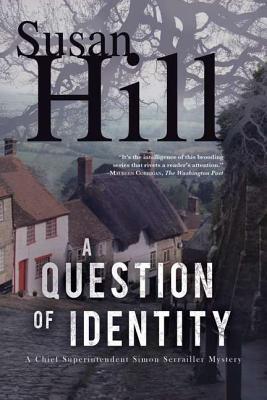
A Question of Identity

Susan Hill's most recent Simon Serrailler novel takes place in Yorkshire in 2002. In the small town of Lafferton, 3 elderly woman have been murdered in their houses. Particularly gruesome crimes, the details are kept from the public. Alan Frederick Keyes has been arrested and is standing trial for them. Keyes is a self employed builder from a nearby town. His wife testifies against him, afraid for her life. The townspeople are convinced he committed the murders, then the jury returns its  verdict. Keyes is taken into police custody and his life changes dramatically.

Flash forward to 2102. In a new public housing project elderly women are again being murdered. The same type of murders as in 2002. So similar are these murders they contain elements from the 2002 crimes - details not released to the public. Has Keyes returned? Possibly, but all attempts to get current information about him indicate he doesn't exist.  Simon Serrailler is assigned to investigate. Simon has his own personal problems going on. His relationship with Rachel is strained, and his sisters and father have problems that are intruding into Simon's life.

Susan Hill is a Man Booker Prize nominee and it's not hard to see why. She writes compelling mysteries with interesting characters. Yes, this is a long running series, but the books are still fresh and the characters keep evolving. I recommend this book and all the others in the series as well.

Check our catalog

Tuesday, April 16, 2013

Mr. Penumbra's 24-Hour Bookstore by Robin Sloan

Part fantasy, part adventure, and total love letter to both old-fashioned typography as well as to modern-day Google (I think the company’s name is mentioned more times than even Penumbra’s), this book is an interesting and provocative read that raises a lot of questions about technology’s impact on humanity and about immortality.

The main character, Clay Jannon, is a recent art school graduate. He’s an even more recent laid-off web designer in San Francisco, which is why he takes the graveyard shift at Mr. Penumbra’s 24-Hour Bookstore, a shop that’s odd in countless ways. Its shape is long, narrow, and tall; its customers are few and eccentric; its stock features books written in code; and its owner—Penumbra—tells Clay, “Prior experience in the book trade is of little use to you here.”

Although you meet a lot of Clay’s friends, roommates, and other associates in the book, the story is plot-driven, rather than character-driven. Everyone Clay seems to know, from his nerdy childhood friend Neel who has become a software genius, to his new hot-looking, data-loving crush Kat, has a skill or connection that advances the storyline. The search to unravel the meaning behind the bookstore’s encrypted books takes Clay, Neel, and Kat to New York City. There they find a black-robed cult of secret scholars also looking to crack the secret language of the books in Penumbra’s store. It’s at this point the story becomes an intriguing cross between Harry Potter and The Da Vinci Code. But this geek fantasy ends back in San Francisco, where Clay learns that the true key to everything that’s important is friendship.

Check our catalog