Tuesday, March 19, 2013

The Other Woman's House

Who hasn't wondered what the inside of a certain house you like looks like? After reading this book you may never look at a real estate website the same way. The Other Woman's House by Sophie Hannah is a psychological thriller with an innocuous enough beginning. Connie Bowskill is a highly suspicious wife. She believes her husband is having an affair while he, of course, denies it. After finding another address in his GPS system labelled as "home" Connie has been obsessed with the house at 11 Bentley Grove and and woman who lives there. When she finds the house listed on a real estate website she decides to take the virtual tour. What she sees will change her life.

A dead body in the lounge (the living room for those of us in the United States) lying in a pool of blood. The image is seared into Connie's brain.  Horrified she wakes up her husband, the computer expert. He looks at the website, watches the tour and no dead body. How can that be? Connie watches the site over and over and still no body. She calls the police to speak to Simon Waterhouse, someone she knows. Unable to reach Waterhouse, as he is out of the country, she is left to deal with his co-workers. And she thinks she is losing her mind - but is she?

And that is the question at the heart of this book. This is one great psychological thriller. The suspense starts building on the first page and just keeps building until the end of the story. The plot line races toward the conclusion where everyone comes to their fate.I read this book in 3 days. I could not put it down. This is the first book I have read by Sophie Hannah but it will not be the last.

Check our catalog

Friday, March 15, 2013

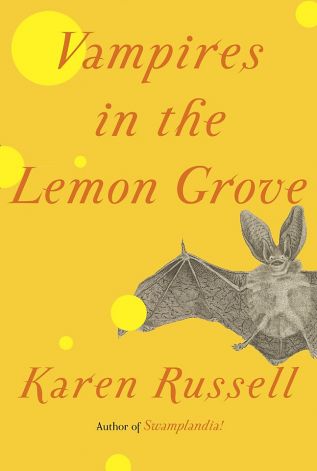
Vampires in the Lemon Grove

Karen Russell is an amazing young author who first came on the literary scene in 2006 with the publication of the short story collection, St. Lucy's Home for Girls Raised by Wolves. This was followed the novel Swamplandia!, a finalist for the Pulitzer Prize (that never was) in 2012.

Now with her new collection, Vampires in the Lemon Grove, Russell has once again proven her amazing skills not only as a skilled writer, but also as a writer of  "realistic fantasy."  All of her stories place the magical and improbable in very human situations.  Her characters, whether vampires in the title story or former presidents reincarnated as horses (The Barn at the End of Our Term) are treated with great empathy as they tackle universal problems.

Take, for example, the title story. In it, two vampires, Clyde and Magreb, are a couple in a long marriage that not only seems like eternity but is eternity. Clyde, was a blood-sucking vampire before he fell in love with Magreb, a vampire who had never tasted blood. They marry, and Magreb takes it upon herself to reform Clyde. They move to a cellar in western Australia, "where the sun burns through the clouds like dining lace." (p. 11) Magreb encourages Clyde to come out of the cellar and experience the outdoors.

After that, and for the whole of our next thirty years together, Clyde explains, I watched the auroral colors and waited to feel anything but terror. Fingers of light spread across the gray sea toward me, and I couldn't see these colors as beautiful. The sky I lived under was a hideous, lethal mix of orange and pink, a physical deformity. (p. 11)

Eventually, Clyde falls into a depression which the blood is not able to fix. "It never fixed it," Magreb reflects. When the couple moves to the beautiful lemon grove in Sorrento, Italy and Clyde uses the lemons as a sort of methadone, the pain of addiction does not leave him. He takes a human form and loses his ability to fly.  By contrast, Magreb soars high above him, choosing the cliffs over a bed with Clyde.

Russell beautifully captures the ebb and flow of love and the struggle of this couple to maintain their affection for each other. And she does so by combining humor with pathos. 

The same quality is true of "The Barn at the End of Our Term." As absurd as the premise of the story is, it works.  The presidents, now deceased and reincarnated as work horses, still suffer from pangs ambition, loneliness and lost love. Russell makes the presidents appear more human to us than they may have seemed from their offices on high.

Vampires in the Lemon Grove employs wit, imagination and compassion. Karen Russell's use of language and style captures the essence of the experience of living. Each of the eight stories in this collection is a gem.

Check Our Catalog

Tuesday, March 12, 2013

The Yellow Birds

The Yellow Birds, by first time author Kevin Powers, is both beautifully written and terrifying at the same time. Powers is an Army veteran of the Iraq war and knows whereof he speaks. The title of the book comes from an Army marching cadence. It eerily fits the theme of the book.

It is the story of 2 Army privates from small towns who meet just as they are about to deploy to Iraq in 2004. Daniel Murphy has just turned 18 - he is both excited and scared and he latches onto John Bartle who is several years older. Bartle feels he is resonsible for Murph and actually tells Murphy's mother he will make sure Murph "gets back." This promise clouds his actions later on in the deployment.

The longer they are in Iraq the more precarious Murph's mental state becomes, until the awful, horrifying end. Bartle is left to deal with Murph's actions in his own misguided way. 

This book is not for the faint of heart. Beautiful, almost lyrical prose is beside graphic descriptions of death and dying. I normally don't read books about the Iraq/Afghanistan wars. This book was an exception. I recommend it, but be careful, while it is a buddy war story they do not always end pleasantly.

Check our catalog

Friday, March 8, 2013

The Light Between Oceans

The Light Between Oceans by M. L. Stedman is a moving novel which explores the often gray line between right and wrong. Tom Sherbourne is back from World War I, where he has witnessed and participated in the atrocities of war. Seeking to heal, he takes a job as the lighthouse keeper on a remote Australian island. The job suits Tom. Here he can continue to serve his country in a capacity that only saves lives. Like the light he maintains to perfection, Tom is guided by his own internal light. He has an innate moral compass--a quality that causes him pain when he recalls the killing he witnessed and committed during the war. The routines of caring for the complicated machinery in the lighthouse provide respite from the chaos he formerly experienced.

All this changes when Tom meets and marries the spirited Isabel. At 19, she is as innocent of life as Tom is tainted by it. The story traces their relationship from the time she comes to live in the lighthouse to her death some 40 years later. In between lies an act that will change their lives forever.

When a boat lies shipwrecked on the beach with its sole survivor-- a baby-- Isabel claims the child as her own. She rationalizes that the mother has fallen overboard; its father lies dead in the hull. Tom becomes complicit it this lie, unable to bear his wife's loneliness and yearning for a child. But unlike Isabel, he is wracked by guilt and the knowledge that he has committed a grievous wrong.

You could kill a bloke with rules, Tom thinks during a sleepless night.  And yet sometimes they were what stood between man and savagery, between man and monsters. The rules that said you took a prisoner rather than killed a man. The rules that said you let the stretchers cart the enemy off from no-man's-land as well as your own men. But always, it would come down to the simple question: could he deprive Isabel of this baby? If the child was alone in the world? Could it really be right to drag her away from a woman who adored her, to some lottery of Fate? (p. 104-105)

Stedman uses evocative language and dark imagery as she describes the island and the surrounding emptiness. One is bound to wonder if the confluence of desperation and isolation can obscure an obvious moral choice. Or is the truth too bright for close examination?

The Light Between Oceans is a riveting book from the first page to the last.

Check Our Catalog

Tuesday, March 5, 2013

The Art Forger

There seems to be an abundance of books on art forgery and theft in the past year. I think I have read them all, and this one is one of the best. While it takes the reader through the Gardner heist, it offers an alternative ending that is wholly satisfying.

Claire is an artist with a scandal in her past. She currently works for an art reproduction company, making copies of other, more classic  and well known paintings. Her specialty is Degas. She has been trained in how to actually forge a painting, so that it looks exactly like the original. Aiden Markel is a mover and shaker in Boston's art world. He knows Claire from the time before the scandal. He approaches Claire with a job offer that is borderline legal: Aiden wants her to copy a painting that was part of the Gardner Museum heist. He is offering her a lot of money and promises to return the original to the museum. Being very short of cash, Claire agrees - and makes a deal with the devil.

The story line focuses on the creation of the copy and the growing relationship between Claire and Aiden.  Filled with technical art terms (plein air, digital wavelet decomposition) the book is interesting in that it gives an education about some aspects of the mechanics of painting. It also gives some interesting glimpses into the world of stolen art. Are they really used as collateral for drug  and arms deals? There are also short asides about real art forgeries written into the story line.

I liked this book mostly because I learned something new from it. It's a short, fast and interesting read. Go visit the Art Institute after you read it, you'll look at the paintings in a different light.

Check our catalog

Friday, March 1, 2013

Interventions: A Novella and Three Stories

Interventions, by Richard Russo, is a beautifully printed set of 4 short works, each of whose cover and opening page is artfully designed by daughter, Kate Russo.

Readers of Richard Russo's fiction are familiar with the rust-belt towns where characters eked out a living. But in "High and Dry," Russo describes Gloversville, N.Y., his boyhood home.  Home to once flourishing glove-making factories, its denizens now live unemployed. When regulations were imposed on these factories forcing them to maintain safety standards and protect the environment from harmful bi-products, the companies moved overseas. Russo writes a glowing indictment of these companies while painting a heart-felt description of his single mother and his grandparents.

"Horseman," the next story in the collection, is the weakest in the group. It features a female professor who has reached a plateau in her career while acknowledging her loveless marriage. Her autistic son has bonded with her husband, making her feel unwelcome in her own home. The problem with the story is that the professor is so distant and self-centered that she draws little sympathy.

This is not the case with the nun in "The Whore's Child."  Cleverly written, it centers on a nun seeking solace in a professor's writing class. The nun's story unfolds in captivating installments as she works out the history of her life through what she has written. The juxtaposition of the nun reading her tale to the young students, and ultimately, seeing the truth through their eyes is a touching literary conceit.

Likewise, "Intervention," the 67-page novella, is a return to Russo's familiar themes. In attempting to help a client pack up the detritus of her life and sell her home, a realtor comes to terms with his own mortality as well as the gifts of a loving wife and good friends. Thinking of his father and his submission to cancer, Ray ponders:

What sort of man comes home from the doctor, calmly sits down in his favorite chair...and waits for his own death as if it would arrive like a slow-moving taxi, plowing dutifully through winter slush? For that matter, what sort of man stubbornly refuses to consider that it need not be this way, that in addition to snow and slush there existed in the known world both sun and clean, sparkling water. (p. 39)

It is only then that Ray recognizes that he, like his father, does not think himself "special" and hence worthy of treatment. Healing, both physically and emotionally, proceeds from recognition of the truth.

Richard Russo is again at his best in this small, insightful and colorful package.

Check Our Catalog

Tuesday, February 26, 2013

At Risk

I had never read anything by Stella Rimington when I saw a review for her new book, The Geneva Trap. I thought I should read the first book in the series before I read any other one so I checked out At Risk. Stella Rimington is an ex-MI5 officer who rose to be the first female director general of the organization. This gives her a great perspective from which to write these books which feature Liz Carlyle, a British intelligence officer. 

Liz Carlyle is a female intelligence officer - a woman in a male dominated and testosterone filled world.  She runs her own group of agents and has a pretty good record for solving problems. While at a joint task force meeting, it is announced that an "invisible" is about to be unleashed by a terrorist group. An invisible is a native of the country that is targeted. There are various view points about this actually occurring, who should be in charge and whether they will share information.  While this is going on, Liz finds herself receiving calls from another controller's agent who is giving her information about a people smuggling operation. When one of the smugglers turns up dead, shot with a specialized method, Liz starts piecing together the information.

Fast paced, with a great storyline, the book is timely. It deals with Islamic terrorists in western countries. While the book is not tech heavy (think Clancy), there is enough spy information to satisfy the espionage junkie. Definitely worth the read.

Check our catalog